


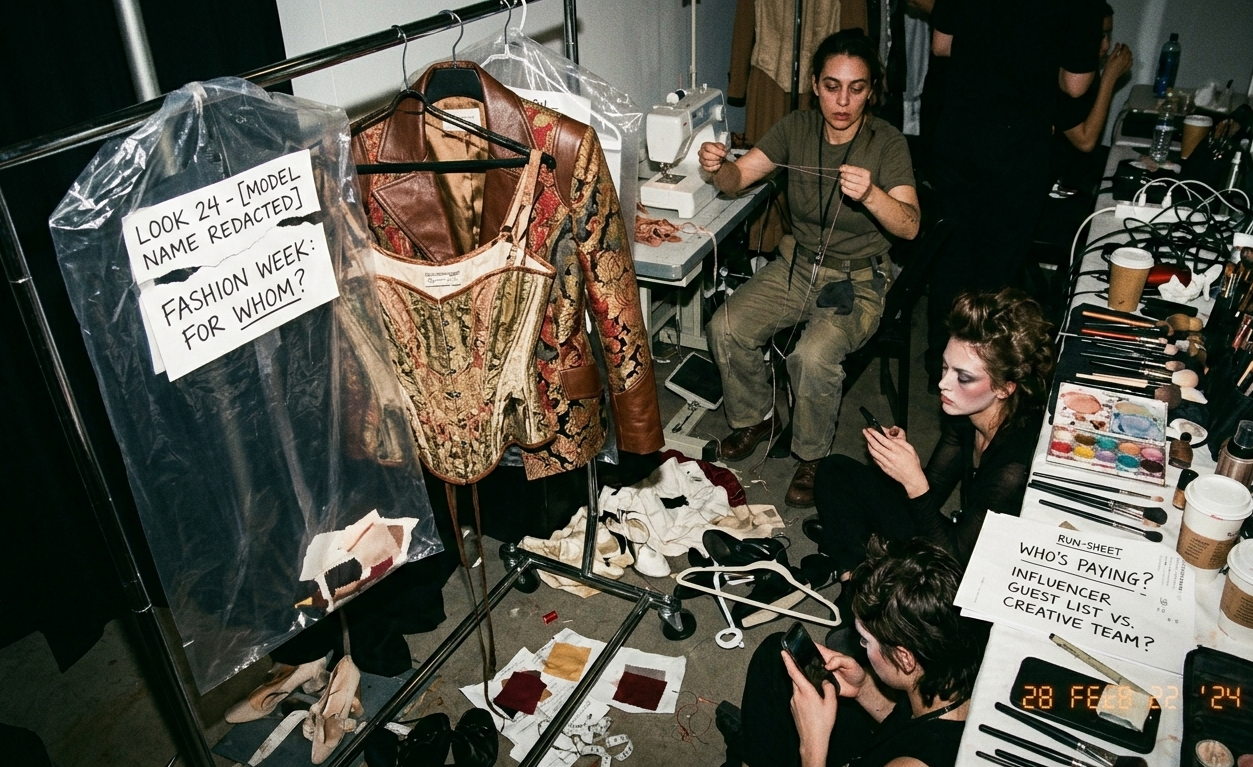
07 Apr Who Is Fashion Week Actually For?
3 min read
Let’s establish something first: the clothes that appear on runways in February and October are, for the most part, not the clothes that will be produced. They are proposals. Arguments. Theatre. The actual collection the pieces that will be manufactured, distributed, and eventually worn by humans on earth will be a negotiated edit of what appeared on the runway, filtered through sales data, wholesale feedback, and the considered opinion of people whose names you will never know.
This is not a scandal. It’s how it works. It has always been how it works.
What has changed is the audience.
Fashion week was invented for buyers and press. Buyers needed to see the clothes move, to understand the proportion, to write the orders that would fund the next season. Press needed to file the reviews that would shape public perception. Both needed to be in the same room at the same time, which created the show as a logistical solution to a commercial problem.
The show became spectacle. Spectacle attracted attention. Attention attracted audiences who were neither buyers nor press but who consumed images of fashion as a form of cultural participation. And then the internet happened, and those audiences became vast and immediate and valuable in ways no one had predicted, and suddenly the show was no longer primarily for buyers or press it was for the feed.
The result is a format that satisfies no one particularly well. Buyers can see the clothes on a digital showroom. Editors are filing for an online audience that will consume a ten-second clip rather than a considered review. The clothes themselves are often designed for the photograph rather than the body and the body, as any woman who has tried to sit down in a runway look will confirm, tends to notice.
And yet fashion week survives. It survives because it is the one moment in the calendar when the industry looks at itself collectively. When everyone is in the same city, attending the same shows, eating at the same restaurants, having the same arguments. The show has become less about the clothes and more about the gathering. It is, in the end, a trade fair that convinced itself it was art.
Which is not necessarily a problem. Trade fairs serve a purpose. Art serves a purpose. The confusion between the two is where things get interesting — and occasionally dishonest.
Fashion week is for the industry. The industry includes you, in the expanded sense that your consumption funds it. But the front row is not made for your benefit, and the reviews written before the lights go up are not written for your illumination.
Knowing this makes watching it considerably more interesting.
No Comments