


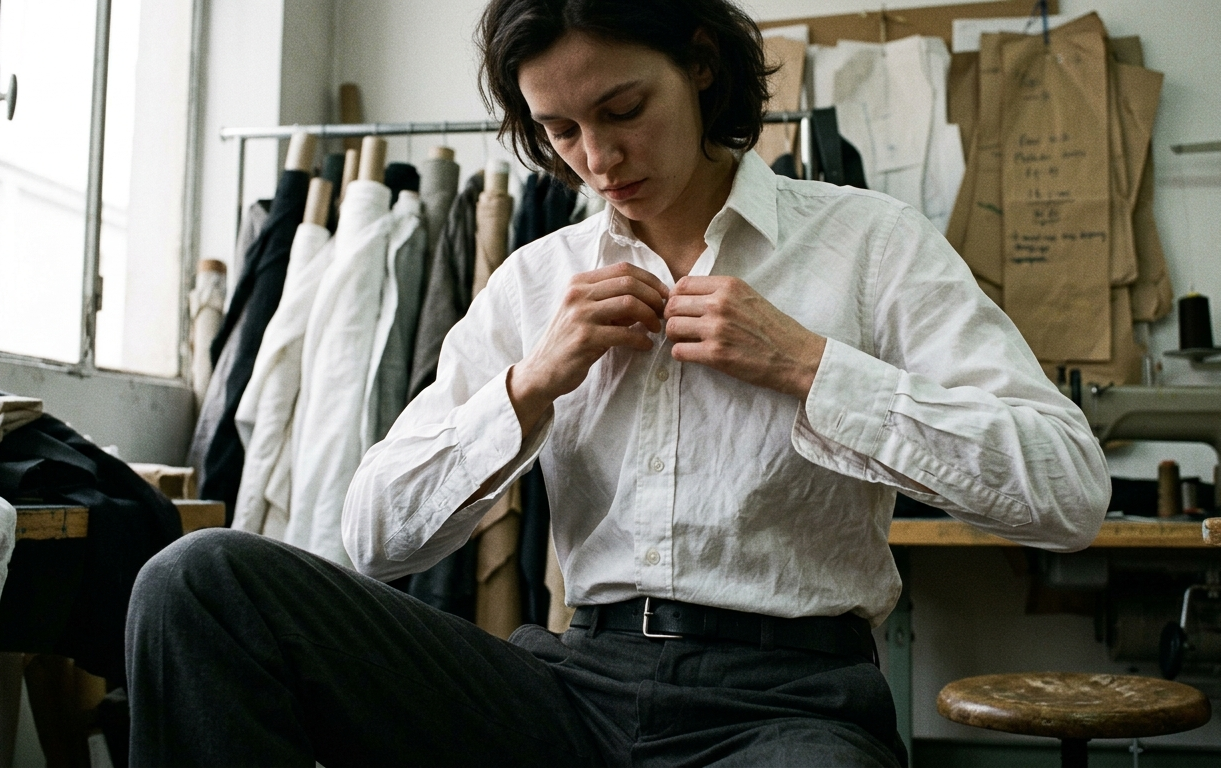
24 May The White Shirt Problem
3 min read
The white shirt is the only honest test in fashion.
Any brand can make an expensive coat look expensive. A heavy wool, a clean silhouette, the right lining, coats carry their price point visibly. They announce themselves. The construction is legible even to someone who doesn’t know what they’re looking for.
The white shirt doesn’t do that. It refuses to perform.
What you see on a white shirt: the collar construction, whether it holds its shape or collapses by noon. The seam allowance, whether the stitching is tight or whether it will fray at the shoulders after four washes. The weave, whether the cotton is dense enough to be opaque or whether it goes transparent under certain light and you’ve paid three hundred euros for something you can’t actually wear. The drape, whether it falls correctly from the shoulder or creates that tell-tale tug across the back that says the pattern was cut for a body type that isn’t yours.
These are not things you can hide with a clever cut or an interesting fabric. A white shirt is a white shirt. It survives or it doesn’t.
The Hierarchy
Charvet on Place Vendôme makes the shirt that everything else is measured against. Made to measure, bespoke collar options, fabric woven specifically for them. The price is what it is. The collar won’t move.
Below that: Officine Générale, whose RTW shirts in end-on-end cotton are probably the most honest value proposition in contemporary menswear. The construction is straightforward. The fabric is what it says it is. Nothing is trying to deceive you.
The Row makes a white shirt. It costs more than most people spend on a week of groceries. What you are buying is a particular hand, the way Sea Island cotton feels against the skin, the way the collar was designed to be worn open without losing its architecture. Whether this is worth it depends entirely on whether you’ve tried it on, which is the only honest answer to a question that expensive.
Then there is the category that requires the most scrutiny: the “premium” basics brand that has decided the white shirt is a content opportunity. The white shirt as flatlay. The white shirt on a model with good bones in a Scandinavian apartment. The white shirt photographed beautifully, described in language borrowed from the tier above, priced to suggest quality without the construction to support it.
These shirts photograph well. They do not hold up.
What to Actually Look For
Single-needle stitching on the side seams. More labour, cleaner finish, better longevity, and you can see it if you look. A collar with a proper interlining, not fused but sewn, which you can feel if you pinch it. Button spacing that accounts for the fact that human bodies move. A placket that lies flat without ironing.
None of this is invisible. All of it is findable if you know you’re looking.
The white shirt is fashion’s most democratic test precisely because it is so unforgiving. A brand that makes a good white shirt understands construction. A brand that makes a bad one, regardless of price, regardless of aesthetic, has told you exactly what it thinks of the person buying it.
The edit starts now.
No Comments